Bendoe
De brief voor de KoningBendoe is a knight among Ristridin’s companions whose insistence on knowing, rather than merely believing, makes him a rigorous judge of Tiuri’s innocence. His own investigation of the Red Shield Knight brings him face to face with a masked opponent’s account of a supposed duel; later, when the Red Riders attack Tiuri, Bendoe helps protect him. His movement from suspicion to trust is measured not by a sudden declaration, but by questions, a newly offered smile, and a parting wish that Tiuri fulfill Edwinem’s mission.
Identity and Approach
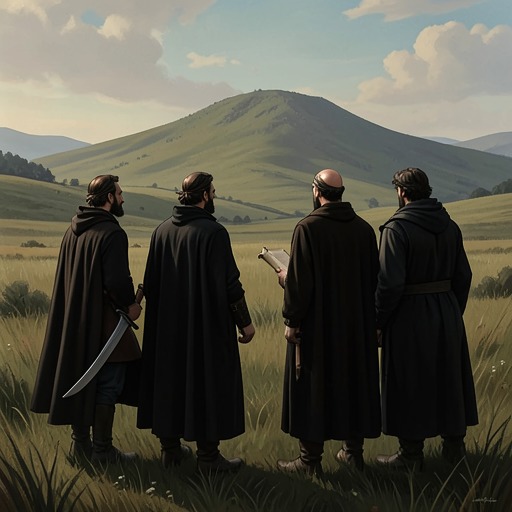
Bendoe appears in the company of Ristridin, Arwaut, and Ewijn as one of the knights whose conduct is at stake when Tiuri is treated as a possible criminal. The Lord of Mistrinaut explains that he gave Tiuri weapons because he doubted the knights’ assumptions and was prepared to intervene. In making his case, he names Bendoe alongside the others and asks what it would have meant for their honor to defeat Tiuri in blind revenge without hearing him. Bendoe is therefore implicated in a conflict not only about who committed murder, but about what justice requires of a knight confronting an accused man.
At first, Bendoe does not let the Lord of Mistrinaut’s confidence settle the question for him. When the lord asks whether Bendoe believes Tiuri, Bendoe makes clear that belief is not the point: he wants to know. Tiuri may be innocent, he allows, but treachery can hide behind an innocent appearance. Before agreeing with the other knights, Bendoe needs an account of who killed the White Shield Knight and grounds for accepting Tiuri’s accusation against the Red Riders and the Black Knight with the Red Shield. His skepticism is not presented as proof that Tiuri is guilty; it is a demand that a grave charge be examined rather than accepted on appearance or allegiance.
Investigation of the Red Shield Knight
Bendoe’s caution rests on firsthand inquiry. After the White Shield Knight was found murdered, Bendoe sought out the Red Shield Knight because he knew of the enmity between the two. He found him in the King’s Forest, south of the hunting lodge, in the company of about six Red Riders. Bendoe asked him to raise his visor and explain what he had done to his opponent. The man removed his helmet, but a black mask remained beneath it, concealing his face.
The masked knight claimed that he had challenged the White Shield Knight to a duel and had been defeated, even saying that he had bitten the dust for a second time and expected to win the next encounter. Bendoe answered that the White Shield Knight was dead. The masked man paused, but the mask made it impossible for Bendoe to tell whether he was surprised. He said that the dead knight had been his enemy and that he was not sorry to hear of his death. Bendoe countered that the man had been murdered, then asked where his Red Riders had been that night and what they could say about it.
The exchange leaves Bendoe with an account, not a transparent confession. The masked knight became angry and said that his riders had been with him; Bendoe replied that he understood the man had more riders than those present. This detail keeps the investigation open: the group Bendoe saw in the forest does not, by itself, settle the whereabouts of every rider or establish who carried out the murder. His narrative to Tiuri supplies the concrete basis for scrutiny while also showing how the mask frustrates certainty. Bendoe neither treats the duel story as an adequate explanation nor claims that his encounter has answered every question.
From Suspicion to Protection
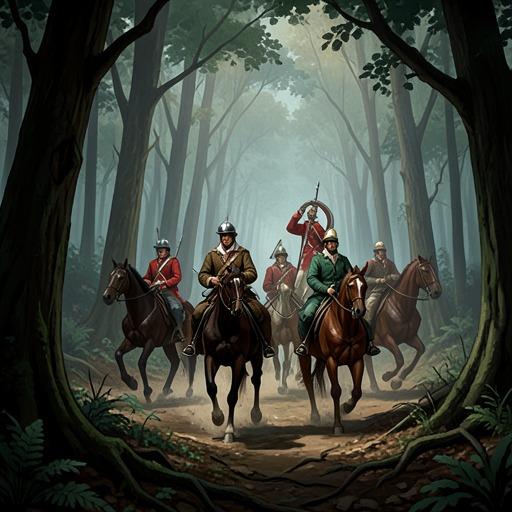
The dispute over Tiuri’s story gives way to a more immediate test when the Red Riders pursue him. After more than an hour, voices and hoofbeats announce the return of Ristridin’s party. Tiuri, who had dozed while waiting, wakes to find all nine of the others back, bringing a man whose hands are tied behind him. Bendoe reports that the knights killed six riders, captured one, and that the others fled. The report establishes the scale of the encounter and its outcome without making the captured man’s identity or later fate part of Bendoe’s account here.
Bendoe then turns from the fight to Tiuri, asking how he is. Ristridin explains that Tiuri has a flesh wound in his arm and that it is not serious. Bendoe wishes him well and says he had feared the injury was worse. He recognizes that the riders were indeed after Tiuri and that traveling with companions had been fortunate. His tone remains as gruff as ever, but Tiuri hears a different note in it. Bendoe’s concern is practical and specific: the attack confirms the danger Tiuri described, and the wound makes that danger immediate rather than hypothetical.
The following morning, Tiuri feels considerably better. Bendoe returns from scouting in the forest with Ristridin and greets him with a smile—the first Tiuri has seen from him. The gesture is small, but it marks a change after the earlier demand for proof. Bendoe has not simply become credulous; the change follows the confrontation with the Red Riders and his own observation of Tiuri’s injury. The smile lets the relationship shift register without erasing the carefulness that defined Bendoe’s earlier response.
Farewell and Narrative Role
When Tiuri and the knights prepare to part, Bendoe gives his farewell a double purpose. He says that Edwinem’s death will be avenged, and he wishes Tiuri success in carrying out Edwinem’s mission. He expresses confidence that Tiuri will manage it, then adds that perhaps they will meet again when Tiuri is a knight, since he should already have been one. Bendoe thus connects the unresolved pursuit of justice for Edwinem with the task Tiuri must continue alone, while treating Tiuri’s eventual knighthood as a possibility he expects rather than a status already attained.
Bendoe also tells Tiuri that the terrain is safe before Tiuri leaves the company. The assurance precedes a separation that nevertheless feels exposed: Tiuri rides away on another horse, later continues on foot through the woods, and takes a rocky route beside the Blue River toward the mountains. Ristridin’s silver horn sounds after he has gone on, offering a final greeting from the group, but Bendoe’s own parting words have already established the terms of their changed bond. He began by refusing to let a plausible appearance substitute for proof; he ends by entrusting Tiuri with a mission and affirming his capacity to complete it. In that progression, Bendoe serves as a measure of how evidence and shared danger can turn suspicion into qualified, consequential trust.